

Leadership team alignment assessment: where is our organization really headed, and does the top team agree?
A leadership team alignment assessment is only useful if it tests agreement on the choices that set direction, not on a values statement everyone has already signed. Ours is Shift Compass. It asks the leaders who set direction eight plain questions about where the organization is headed, works out the operating identity their answers point to, and measures how far the team actually shares it. When they don’t share it, it says so before anything is built on top: clarify direction first.
Best when a strategy shift is coming and leadership team alignment has to be settled before you measure anything against it.
What a leadership team alignment assessment should settle
Most alignment surveys ask leaders how aligned they feel. That measures confidence, not agreement. Shift Compass never asks. Each leader answers the same questions on their own, and agreement is computed from the spread of their answers.
| Question | What it settles |
|---|---|
| What is your organization fundamentally in the business of doing? | The core model: delivering to many, deep expertise for each client, connecting two sides, shared infrastructure, or convening a membership or field. |
| Who do you serve, and who funds you? | Whether the payer is changing, and whether you serve two very different groups at once. |
| Why choose you over the alternatives? | The basis of distinctiveness: cost, the best offering, being first, the relationship, prestige, or solid across the board. |
| Where is the organization in its lifecycle? | Starting-up, Expanding, Sustaining, Consolidating, or Renewing. |
| If you stay still, who else could gain an edge, and how fast? | Urgency: Imminent, Building, Distant, or None. |
| What are you not allowed to do? | The guardrails your charter, mandate, members, funders or regulator set, even where crossing them would pay off. |
| How readily can you attract and keep the people needed? | Whether the direction can actually be staffed. |
| One organization, or several under one roof? | One target for the enterprise, or a target per unit. |
The ninth question, whether your leaders agree, is never asked. It is measured.
Every question ends in “Mixed / unclear,” and that answer raises a flag rather than forcing a result. Short follow-ups open only when an answer needs separating, for example whether control is the defining requirement of the operation or a boundary it works within. The wording adapts to commercial, nonprofit or association, and public or regulated organizations. The questions underneath stay the same.
How agreement is read
Each question is banded by the share of leaders who chose the most common answer.
- Aligned. A settled, shared picture on this question.
- Partial. Rough agreement, with a real second answer in the room.
- Divergent. Leaders are answering a different question. Two near-equal camps count as Divergent whatever the percentages say.
Three questions decide the readiness gate: which business you are really in, who you serve and who funds you, and whether you are one organization or several. If any of the three is Divergent, the read is Clarify direction first, before an org chart or a headcount plan is designed around a strategy the team hasn’t chosen.
Naming that stop is worth more than any single score.
A spread is not always a failure. In an organization with genuinely distinct units or constituents, it can reflect how the place actually works. Either way, the next step is the same: decide whether you need one enterprise target or a target per unit.
How the leadership team alignment assessment runs
- The 8–15 leaders who set direction, including board members, senior leaders, and business or unit leaders
- Eight questions, plus follow-ups where an answer needs separating, then optional open questions on the current and future state
- An online poll, 1:1 interviews, or both. Facilitators can add interview notes under every question, and someone interviewed but not surveyed still counts in the synthesis
- Code names, not real names. Each respondent picks their own two-word code name
- The facilitator sees the results. Respondents do not see each other’s answers
- Facilitated by IPL inside an engagement, and run before Strategy-Fit when both are used
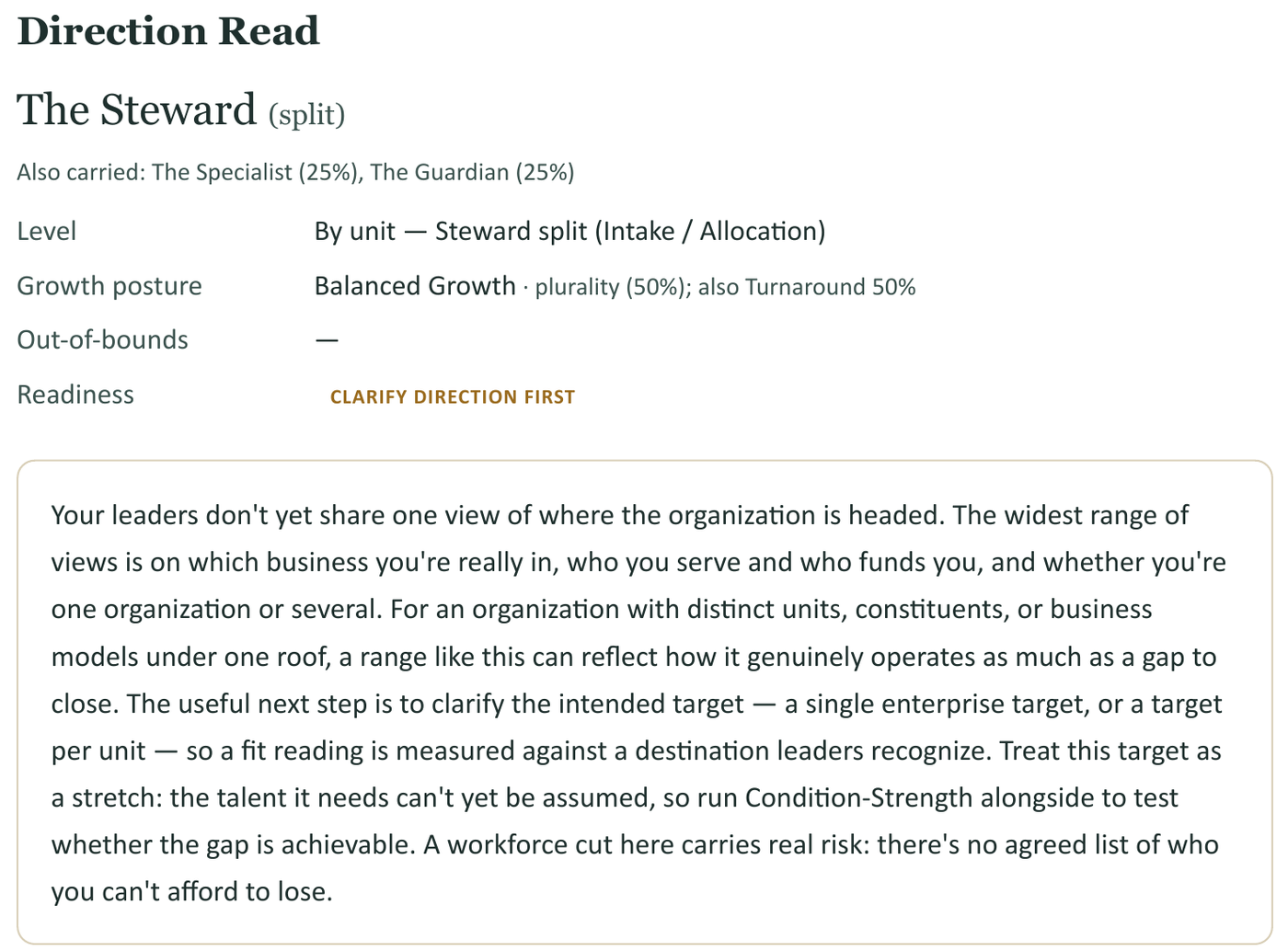
What you get: the Direction Read
One page a facilitator can act on, built from the team’s answers.
| Part of the read | What it tells you |
|---|---|
| Target | The operating identity your leaders’ answers point to, such as the Optimizer, the Pioneer or the Concierge, with the answers that proposed it. |
| Growth posture | Rapid Growth, Balanced Growth, Defend & Harvest, or Turnaround, from the lifecycle stage and urgency. |
| Level | One organization measured against one target, or a target per unit. |
| Out-of-bounds | Directions your guardrails rule out regardless of fit. |
| Readiness | Ready to measure fit, or Clarify direction first. |
| Flags | Plain-language warnings, each with what to do. For example: the talent this direction needs may be a stretch. |
Then a short narrative assembled from fixed phrases. Every sentence traces back to the answers that produced it, so the read never says something the data didn’t. Alongside it: the full spread of answers on every question, for showing the room where it lands, and every open-text answer read as a set, so you can see whether leaders are describing the same organization in their own words.
From direction to fit
Shift Compass sets the target; Strategy-Fit tests the fit. When the read is Ready to measure fit, the target and growth posture carry into Strategy-Fit in one step, so the operating model assessment measures today’s operation against a destination your own leaders chose rather than one a consultant assumed. If the talent flag fires, Condition-Strength runs alongside it to test whether the gap is achievable or aspirational.
Questions about this leadership team alignment assessment
How is this different from a team effectiveness survey?
A team effectiveness survey measures how a team works together: trust, conflict, meetings, follow-through. A leadership team alignment assessment measures whether the team agrees on where the organization is going. A team can work together well and still be describing different organizations.
What happens if the result is “Clarify direction first”?
You have learned the most useful thing the instrument can tell you, and learned it before acting on it. The read names the questions where views split and the ones where leaders converge, which is the common ground to build the conversation from.
Does it work for nonprofits, associations and public bodies?
Yes. The organization type changes the examples in each question, so customers become members, beneficiaries or constituents. The answer options cover organizations that convene a membership, connect funders with recipients, or run shared infrastructure, and the guardrails question exists because charters and mandates rule some directions out.
Is the narrative written by AI?
No. It is assembled from a fixed library of phrases, each tied to a rule. The same answers always produce the same read.
See what Shift Compass would show about your top team. A 30-minute discovery call, no prep needed. Tell us about the strategy shift ahead, and we will walk you through the Direction Read it produces. Request a walkthrough →
Shift Compass is one of six diagnostics in the Shift Diagnostics Suite. See them side by side, or read about the operating model assessment.