

Operating model assessment: how do we actually operate today, and does that fit what our strategy needs?
An operating model assessment should tell you more than how you operate: how far that sits from what your strategy needs, and whether your people agree on the starting point at all. Ours is the Strategy-Fit Diagnostic. It reads 24 operating choices across six Conditions, measures each against a target derived from your strategy, and gives every gap a recommended move.
Best when the strategy is clear, but the organization’s design and habits may be pulling against it.
Request a walkthrough → · Get the sample report →
What an operating model assessment measures
Twenty-four dimensions, four in each of six Conditions. Every dimension is a pair of statements, and people place the organization on an eight-point scale between them. There is no neutral midpoint, so everyone has to lean one way.
| Condition | What it covers | One of its four pairs |
|---|---|---|
| Clarity | Direction and how we decide | “We make key decisions based on data and rigorous analysis” or “based on our leaders’ experience and judgment” |
| Connection | How we’re structured and coordinate | “We escalate important decisions to senior leaders” or “We delegate important decisions to those closest to the work” |
| Confidence | How we set standards and measure | “We judge success mainly by efficiency and cost” or “by customer and relationship outcomes” |
| Capability | How we source and deploy talent | “We hire proven experts who add value immediately” or “We hire for potential and develop people over time” |
| Capacity | How we focus effort and resources | “We plan thoroughly before we act” or “We act quickly and adapt as we learn” |
| Change-Agility | How we learn and renew | “We favor making incremental improvements to what works” or “We pursue bold, breakthrough change” |
Neither pole is better. The right target depends on strategy.
That is what separates this from most organizational surveys, where a higher score is always the goal. A bank and a biotech should answer the Capacity questions differently. The assessment’s job is to show whether yours answers them the way your strategy needs.
Where the target comes from
Respondents rate how the organization operates today. They do not vote on the target. The target is derived from two declarations: the operating identity your strategy calls for, such as the Optimizer, the Pioneer, the Concierge, the All-Rounder or the Dual-Track, and the phase you are in: Rapid Growth, Balanced Growth, Defend & Harvest, or Turnaround.
The identity answers what strategy. The growth posture answers what phase. Together they set a target point on all 24 dimensions. Some identities carry requirements a simple blend cannot produce. The Guardian, for example, holds its risk controls at the maximum whatever else is true, because preventing one catastrophic failure is the reason it exists.
Run Shift Compass first and both declarations come from your own leaders’ answers, carried across in one step.
Two reads on every dimension
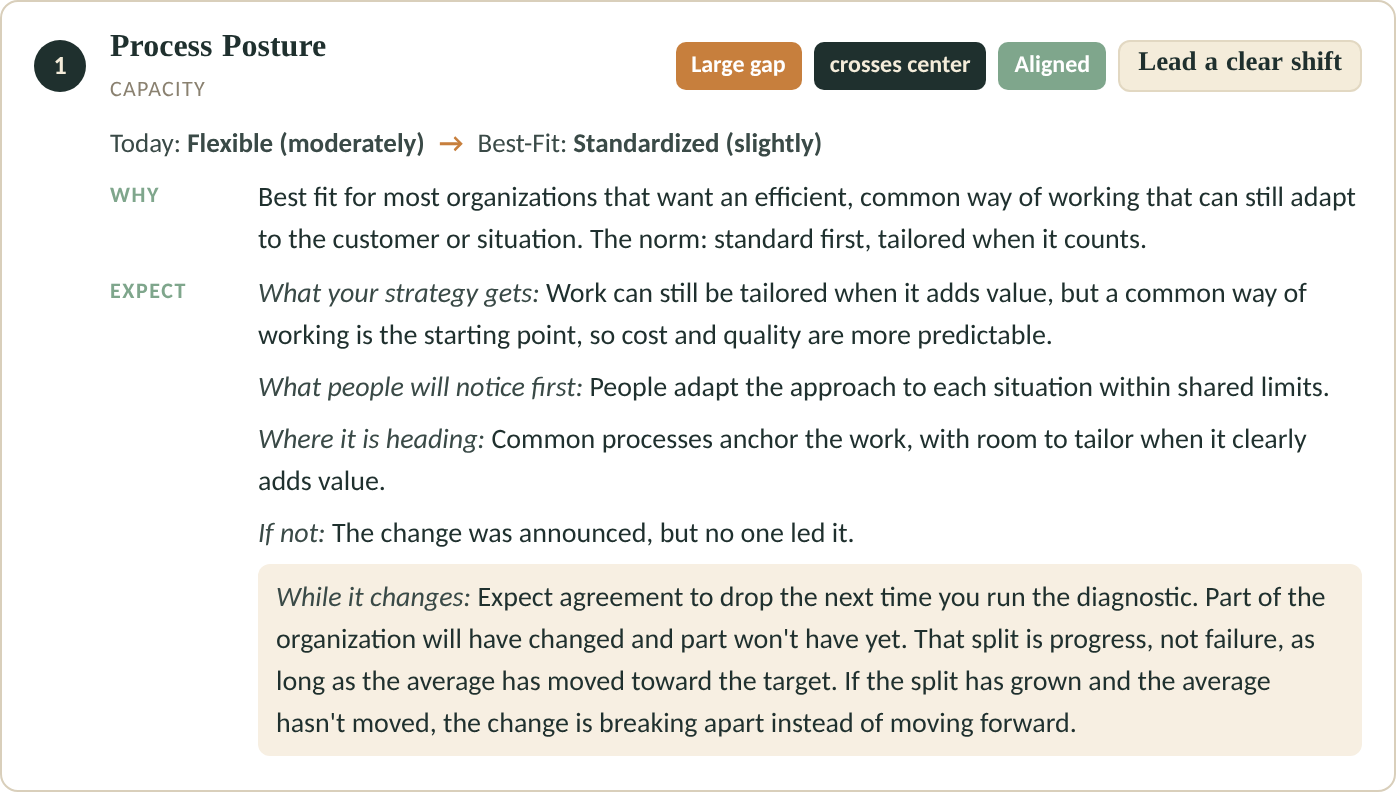
Fit gap is the distance between where people say you operate and where the strategy needs you: On-Fit, Small gap, or Large gap. If today and the target sit on opposite sides of the scale, the gap counts one band more severe. Flipping a pole is harder than changing how strongly you hold one.
Agreement is how far people share one picture: Aligned, Partial, or Divergent. Together the two reads place each dimension in one of nine cells, and each cell carries its move.
| Divergent: align first | Partial: confirm as you move | Aligned: act | |
|---|---|---|---|
| On-Fit | Confirm & align | Confirm, then sustain | Sustain & build on |
| Small gap | Reconcile | Align, then nudge | Hold & protect |
| Large gap | Align first, then shift | Firm up, then lead | Lead a clear shift |
You cannot shift what people don’t agree exists.
Agreement works as a gate with three states: open when Aligned, ajar when Partial, closed when Divergent. It also guards against the most flattering misread in any operating model assessment. An On-Fit average with a wide spread is not a strength. It is an agreement problem wearing a good average.
How the operating model assessment runs
- 24 paired statements, each rated on an eight-point scale with no midpoint
- A cross-section of the organization, across levels and business areas
- Built to resist autopilot. One fixed order for everyone, with 11 of the 24 pairs reversed on screen so nobody can coast down one side. Respondents never see the Condition labels
- Link or QR code. Participants go straight to the survey, and results update live for the facilitator
- Pooled, never attributed. A role level is shown only when 5 or more people sit in it
- Facilitated by IPL, from setting the target through to a working session on the map
What you get
- The Prioritized Shift Agenda. No more than three moves, ranked by how much each matters to your strategy, not by how big the gap looks. Each one says why it matters, what your strategy gets, what people will notice first, and what it means if they don’t. Plus what to protect, and what looks on-fit but isn’t settled
- The Fit × Alignment Map. All 24 dimensions placed by fit gap and agreement, each with its recommended move
- The Five-Signal Read on every dimension. Lean, Common Ground, Agreement, Camps, Gaps: which way the business runs, the most common lived experience, how far people share it, where groups run by different rules, and how far today sits from the target
- A Condition roll-up that shows the spread inside each Condition, so a calm average never hides a split underneath
- A comparison by role level. Each level’s view on all 24 scales, side by side, which shows where senior leaders and everyone else describe different organizations
- Presentation-grade charts for any dimension, ready for the leadership session
Questions about this operating model assessment
How is this different from the change readiness assessment?
Both read the same six Conditions, but they ask different questions. The change readiness assessment measures whether each condition is present, and there more is better. An operating model assessment measures posture, where neither end is better and the right answer depends on strategy. One tells you whether the foundations are in place. The other tells you whether the building fits its purpose.
What if we haven’t settled our target yet?
Run Shift Compass first. It resolves the operating identity and growth posture from your leaders’ own answers, or tells you plainly that direction isn’t settled. Without a target, the lean, agreement and camps on each dimension still stand. Only the fit gap needs one.
What if we are really two businesses under one roof?
Some organizations run two opposed operating models, such as one side that wins resources and another that deploys them. Strategy-Fit scores each model separately, then reads the seam between them: how separate they should be, who settles conflicts across the boundary, how capital crosses, and which systems they share. The seam is often where the strategic problem actually sits.
Why do respondents only rate today?
Because a target set by vote averages away the choice the strategy is supposed to make. People are the best source on how the organization really operates. The strategy is the source on where it needs to be.
See what the Strategy-Fit Diagnostic would show about your operating model. A 30-minute discovery call, no prep needed. Tell us what the strategy asks of the organization, and we will walk you through the Prioritized Shift Agenda and Fit × Alignment Map it produces. Request a walkthrough → · Get the sample report →
Strategy-Fit is one of six diagnostics in the Shift Diagnostics Suite. See them side by side, or read about the leadership team alignment assessment. Shift Compass sets the target; Strategy-Fit tests the fit.