

Change readiness assessment: are the conditions in place for our strategy to succeed?
A change readiness assessment should answer one question — is this organization actually set up to deliver what the strategy asks of it? Ours is the Condition-Strength Diagnostic. It measures six conditions across 36 facets, scores each from 0 to 100 against targets you set, and names the few moves that matter most — with what you should expect to change if each one works. Just as usefully, it names what not to start yet, and why.
Best when the plan is sound but execution keeps stalling, and you need to know which condition is missing.
What a change readiness assessment measures
Six conditions distinguish organizations that convert intent into results from those that don’t. Each is read through six facets — 36 in all — and every facet is a plain statement people rate from their own experience. No jargon, no acronyms, nothing anyone has to decode.
| Condition | Focus area | The question it answers |
|---|---|---|
| Clarity | Direction | Do we know where we are going and why? |
| Connection | Ways of Working | Do our structures and relationships support execution? |
| Confidence | Reliability | Do commitments translate into outcomes? |
| Capability | People Readiness | Do we have the right capabilities in the right roles? |
| Capacity | Resource Alignment | Are we focused on and investing in what matters most? |
| Change-Agility | Adaptability | Are we learning and responding as conditions change? |
How to read the numbers
Every facet carries an Index from 0 to 100. It reads how deeply established the condition is — not how much people like it.
| Index | Band | What it means |
|---|---|---|
| 85–100 | Proven | Holds under pressure. Rare — treat it as a differentiator. |
| 70–84 | Dependable | Keeps working without anyone driving it. |
| 60–69 | Adequate | More true than not, but it varies. Clears the line, but not yet dependable. |
| 45–59 | Partial | True in some ways, but clearly limited. |
| 30–44 | Minimal | True rarely, or only in limited ways. |
| 0–29 | Not in Place | Not true here. There is nothing yet to spread. |
60 is the line. Below it, the condition holds the organization back. From 60 it starts to help, but it only holds on its own from 70.
Because the Index averages people who see things differently, most facets land in the middle of the scale. The bands are cut to tell facets apart where they actually fall, not across a theoretical spread.
Two reads, not one
A single average hides the most important finding. Strength says how far a condition has traveled. Alignment says how widely that view is shared — and the two together point at different first moves. Five of them.
- Low strength, widely shared. Everyone agrees it is absent. A systemic gap, and the easiest business case you will ever make.
- Low strength, two camps. It exists for some people and not others. Averaging them is actively misleading.
- Mid strength, widely shared. Uniformly half-there. Usually one obstacle to remove, not a program to launch.
- Mid strength, two camps. Real pockets of strength. Find them and spread them.
- Just above 60, widely shared. It works, but only while someone keeps it up. Remove what makes it fragile before relying on it.
Two facets can both score 40 and point to different problems — one tells you where to look, the other what to build.
The report places all 36 facets on a strength-by-alignment grid and names the move for each cell, from “protect and build on” to “build the baseline.”
How the change readiness assessment runs
- 36 statements, six per condition, rated from the respondent’s own experience
- Three optional open questions: what to protect, what gets in the way, and the one thing you would change
- A broad cross-section of employees, spread by business area and by level, so the report can show where leaders and the front line see different things
- A six-point scale where each rung describes what the condition depends on to stay true, with “Not visible to me” on every item — excluded from scoring rather than guessed at
- Pooled, never attributed. Nothing is reported on fewer than five responses — per item, not per survey
- Facilitated by IPL, from framing and targets through to a working session on what it found
What you get
A change readiness assessment is only worth the moves it produces. Four deliverables, all client-ready.
- A group results report — the six conditions, every facet, where to start, what to expect from each move, what to protect, and what people wrote in their own words
- A facilitator edition — the same report with the reading behind each score, and the questions to ask the room
- A live dashboard — results as they land, with the facet drill-down, role-level comparison and alignment reads
- Verbatim comments — unedited, behind the privacy floor. Usually the part that is read first
See the full overview (PDF)The six conditions, how the Index and the bands work, the two reads, sample results, the Leadership Index and where to start. Fifteen pages, no sign-up. Open the overview →
The Leadership Index
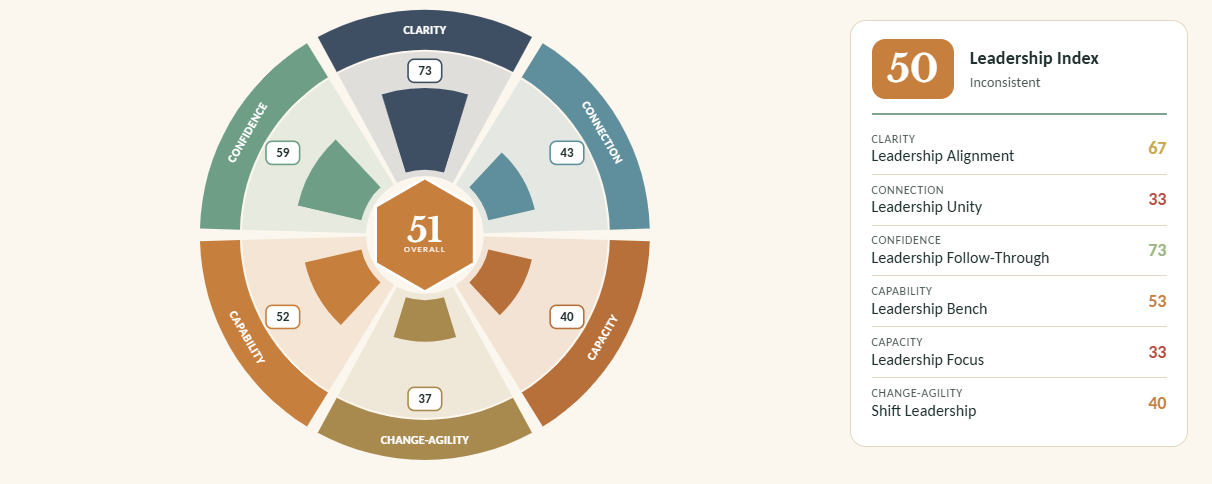
One facet inside every condition is about leadership. Together they form a single band running through all six, and a Leadership Index read on its own — including the gap between how senior leaders rate themselves and how everyone else rates them.
In our sample dataset (invented data), senior leaders saw the organization more favorably than everyone else did by nine points across the board. On leadership itself, that gap widened to thirteen. The distance is greatest where the subject is them.
Where to start
Gaps are ranked by shortfall against target, with two rules applied.
- Facets that split the organization are set aside until the split is reconciled. You cannot shift what two groups disagree exists.
- Where one facet must be in place before another can move, the chain is worked in order — so the sequence, not just the ranking, is what you get.
The result is a short, sequenced list, each item with a specific first move at enterprise level and at the level of an individual leader. There is also a page on what to protect: the conditions that hold on their own, and the specific way each one is lost. Most strengths go by neglect rather than by decision, and a gap ranking will never say so.
What to expect from each move
Every move also names what you should expect. Not a predicted score — there is no normative database behind one, and a number we miss is worse than no number at all. What you get is the observable change, in your organization’s language, and what a non-result would mean.
Expect: the workarounds disappear and rework drops. If they don’t, the stalls were about priorities, not process.
This is what makes the second read worth running. A remeasure with nothing predicted produces a fresh set of numbers beside the old ones. A remeasure against stated expectations is a scorecard — and it tells you which moves worked, which were the wrong move, and which were right but blocked by something upstream.
Questions about this change readiness assessment
How is this different from an engagement survey?
An engagement survey measures how people feel about working here. A change readiness assessment measures whether the conditions your strategy depends on are actually established, and how consistently. The scale reads what a condition needs in order to stay true, not whether people approve of it.
Can people’s answers be traced back to them?
No. Responses are pooled and never attributed, and nothing is reported on fewer than five responses — applied per item, not per survey. Comments are shown only once at least five people have written something, and are sorted so no one’s answers can be read as a set.
How often should we run it?
Six to twelve months apart. The Index is built to be run again, and the second read is where the value compounds: it shows whether the moves worked, and which conditions drifted while attention was elsewhere.
What if we have already run a change management assessment?
Most of them score one change. This scores the conditions underneath every change — which is why it still has something to say after a specific program has finished.
See what the Condition-Strength Diagnostic would show in your organization. A 30-minute discovery call, no prep needed. Tell us where execution is stalling, and we will walk you through the report this produces. Request a walkthrough →
Condition-Strength is one of six diagnostics in the Shift Diagnostics Suite. See them side by side, or read about the operating model assessment, which reads the same six conditions as operating posture.