

Change fatigue assessment: how much change is each person actually navigating?
Try it free on one change
My Shift Atlas analyzes every change a person is navigating. Start with one: yours.
The Transition Persona Check is free, with no sign-up, and your answers stay anonymous.
A change fatigue assessment that asks about one change will miss most of it. Ours is My Shift Atlas. It asks each person about every professional shift they are living through right now — because four changes at once is not one change, four times.
Your people are navigating four changes. You’re managing one.
Best when your people are working through several changes at once and you need to help, without asking anyone to expose themselves.
Talk to us about licensing a block of seats → · Get the sample report →
Why a change fatigue assessment has to ask about all of them
Most change instruments ask about one change. This one asks about all of them at once, and that single design decision is where everything below comes from.
People under-report. The shift that is nearly finished still takes something. The one you have gotten used to is still there. So the instrument sets one test for what counts — it’s done when you no longer think about it — and then asks for all of them. Up to five are scored in full. Beyond that, a person can keep naming shifts without rating them, and the count itself becomes the finding:
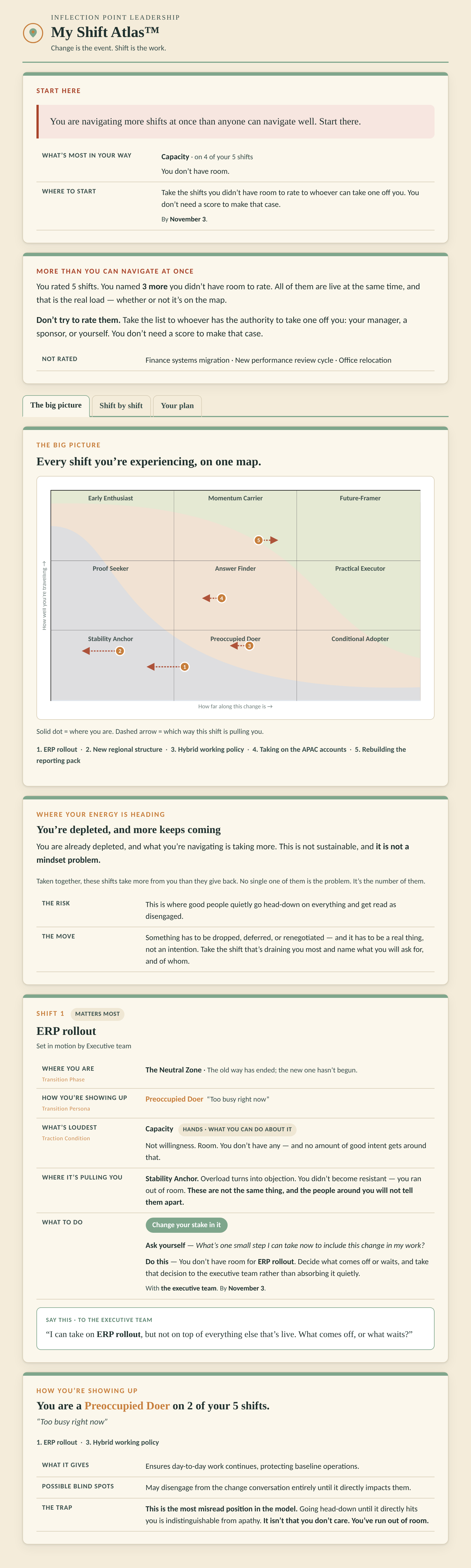
You rated five shifts. You named three more you didn’t have room to rate. All of them are live at the same time.
No instrument that caps at one change can produce that sentence.
What it reads
- Where each shift has the person — plotted on the nine Transition Personas™. A persona is a situational read, not a type: it changes by shift and over time, and none of the nine is the wrong one to be.
- Headwind or Tailwind — what each individual shift does to that person’s time and energy, on a signed scale from “gives me room” to “more than I can take.”
- Who set each change in motion — the executive team, a divisional leader, their manager, a colleague, or themselves.
- Which layer is loudest — the report reads four framework layers at once and points at the one most in the way, because two people with the same persona often need different advice.
Four findings a single-change survey cannot produce
It isn’t apathy. They ran out of room.
The most misread person in any change is the one who has gone quiet. Everyone reads it as resistance. The load measure, set against what the person is already absorbing, says the other thing plainly: this is not sustainable, and it is not a mindset problem.
It isn’t “change” they don’t trust. It’s one source.
Because the instrument captures who initiated each shift, it can cross that against how the person is showing up. Someone can be a Momentum Carrier on everything their manager starts and a Stability Anchor on everything the executive team starts. That is not a change problem — and it will be diagnosed as that person’s resistance if nobody names it first.
Arriving is not the same as arriving well.
Compliance is not commitment. The grid separates how far along someone is from how well they are traveling, and the two move independently. A person can execute every change perfectly and reach the end of the journey fully executed, fully compliant, fully unconvinced. Nobody notices until the change needs someone to care.
The effort is real. It just lands in the wrong place.
Most friction in a shift does not come from bad intent. It comes from responding at the wrong layer — pushing harder when the real problem is not understanding the change, or asking for more detail when the real problem is having no room. The report names the loudest layer and gives one action against it.
How the change fatigue assessment runs
- About 15-20 minutes the first time, then about 10 minutes for each later check-in
- Self-serve. Each person completes it on their own, whenever their changes move
- Licensed by the organization as an annual seat, with a 25-seat minimum. A seat is a full year of unlimited use
- Organizations of 100 seats and above can add a Cohort Report
- Professional shifts only. Personal load enters the model as context, through one question — a design position, not a limitation
What the organization sees — and what it never sees
The name is the design. My Shift Atlas belongs to the person who took it — not to their manager, not to anyone else in their organization, and not to IPL.
You never see a person’s answers, their map, or their name. You see only what is true of enough people that it is no longer about any one of them.
Four proofs, all enforced in the database rather than in a policy document:
- A minimum of eight responses on every cut, with no setting to lower it
- No individual drill-down exists — not for the buyer, not for a facilitator, not for IPL
- Who set a change in motion is reported organization-wide only, never sliced small enough to point at one manager
- Nothing a person writes is ever exported
If you could read it, nobody would answer it honestly — and you would have bought a very expensive lie.
One more thing worth saying before you ask: below roughly forty completed check-ins, that eight-response floor suppresses almost every cut. A 25-seat purchase buys a pilot, not a Cohort Report. We would rather tell you that now than sell you a report you cannot use.
What a change fatigue assessment tells you first
Every report opens with the same three things, before the map and before any detail. Someone who reads only this block has still gotten something they can act on in the next two weeks.
| Start here | What it gives them |
|---|---|
| The state | One sentence naming what this set of changes actually is — for example, “You are navigating more shifts at once than anyone can navigate well.” |
| What’s most in the way | The single condition doing the most damage across every shift, named in plain language, with the count when it is loudest on more than one of them. |
| Where to start | One action, with whom, and a real date on it. Never “soon.” |
Then the map: every shift the person is navigating, plotted on the nine Transition Personas™, each with an arrow showing which way that change is pulling them. Five dots on one picture is a reading no single-change survey can produce.
What each person gets
The output of a change fatigue assessment belongs to the person who took it. They get five things.
- Start here — one sentence naming what this portfolio is, what is most in the way, and one action with a date on it
- The big picture — every shift on one map, and what the mix says about how they are navigating all of it
- Shift by shift — where each change has them, where it is trending under its load, and what to do about it
- Your plan — written prompts seeded with their own results, saved and returned to when the changes move
- A PDF they keep — the artifact they bring to the conversation the report told them to have
You rarely control the change. You always have influence over the shift.
Questions about this change fatigue assessment
Is this a personality test?
No. There are nine personas and none of them is the right one to be. A persona is a reading of how someone is navigating a particular shift at a particular moment — it moves between shifts and it moves over time. Staying where you are is a legitimate outcome for all nine.
Is it AI?
No. Its scoring engine is deterministic: the same answers always produce the same results.
What if someone is navigating more than five changes?
They keep naming them. Beyond the fifth, shifts are counted rather than scored — which protects the scoring while making sure the most overloaded person in the organization is not the one the instrument under-measures.
Can we see an individual’s results?
No, and not by request. There is no screen, no export and no process that produces one. That constraint is why the answers are honest.
How does this differ from running a survey about our transformation?
A program survey tells you how one change is landing. A change fatigue assessment tells you what each person is navigating in total — including the three changes nobody has asked them about. Both are useful; only one of them finds change fatigue.
Find out what your people are actually navigating. Tell us about your team and we will size a seat license for My Shift Atlas, share pricing, and answer the privacy questions your people will ask. Talk to us about seats →
My Shift Atlas is one of six diagnostics in the Shift Diagnostics Suite. See them side by side, or read about the change readiness assessment. The closest of the six is Our Shift Journey, which reads how an organization is navigating one change — where My Shift Atlas reads how each person is navigating all of them.