

Change leadership 360 assessment: who makes change happen, not just navigates it, and what is each person’s next step?
A typical change leadership 360 assessment measures how well a person copes with change: resilience, adaptability, comfort with ambiguity. Ours is the Shift-Maker Profile. It measures something harder to see and more useful to grow: whether change starts with this person, as the people who work with them have seen it, and the one next step that would grow it.
Best when you’re developing leaders or high-potentials and want to know who is driving change, and how to grow that.
Talk to us about the Shift-Maker Profile → · Get the sample report →
What this change leadership 360 assessment measures
Most capable people navigate change well. They absorb it, adapt to it, and keep their own work on track. That matters, and it is not the same as making change happen: starting things nobody asked them to start, and creating movement in people and work they don’t control. A person can navigate change excellently and still make none of it happen. The Shift-Maker Profile is built to show the difference.
It reads six areas, one for each of the six conditions in the Shift Leadership Framework™. Each area is written as the behavior that makes change happen, and each one names what it creates for the people around the leader.
| Area | What raters look for | What it creates for others |
|---|---|---|
| Clarity | Paints a clear picture before all the facts are in | Enlightened |
| Connection | Rallies people they don’t directly lead | Engaged |
| Confidence | Makes safe-to-try moves without waiting for certainty | Entrusted |
| Capability | Keeps their skills ahead of the work | Equipped |
| Capacity | Frees up capacity for what matters most | Effective |
| Change-Agility | Adjusts course as the evidence changes | Empowered |
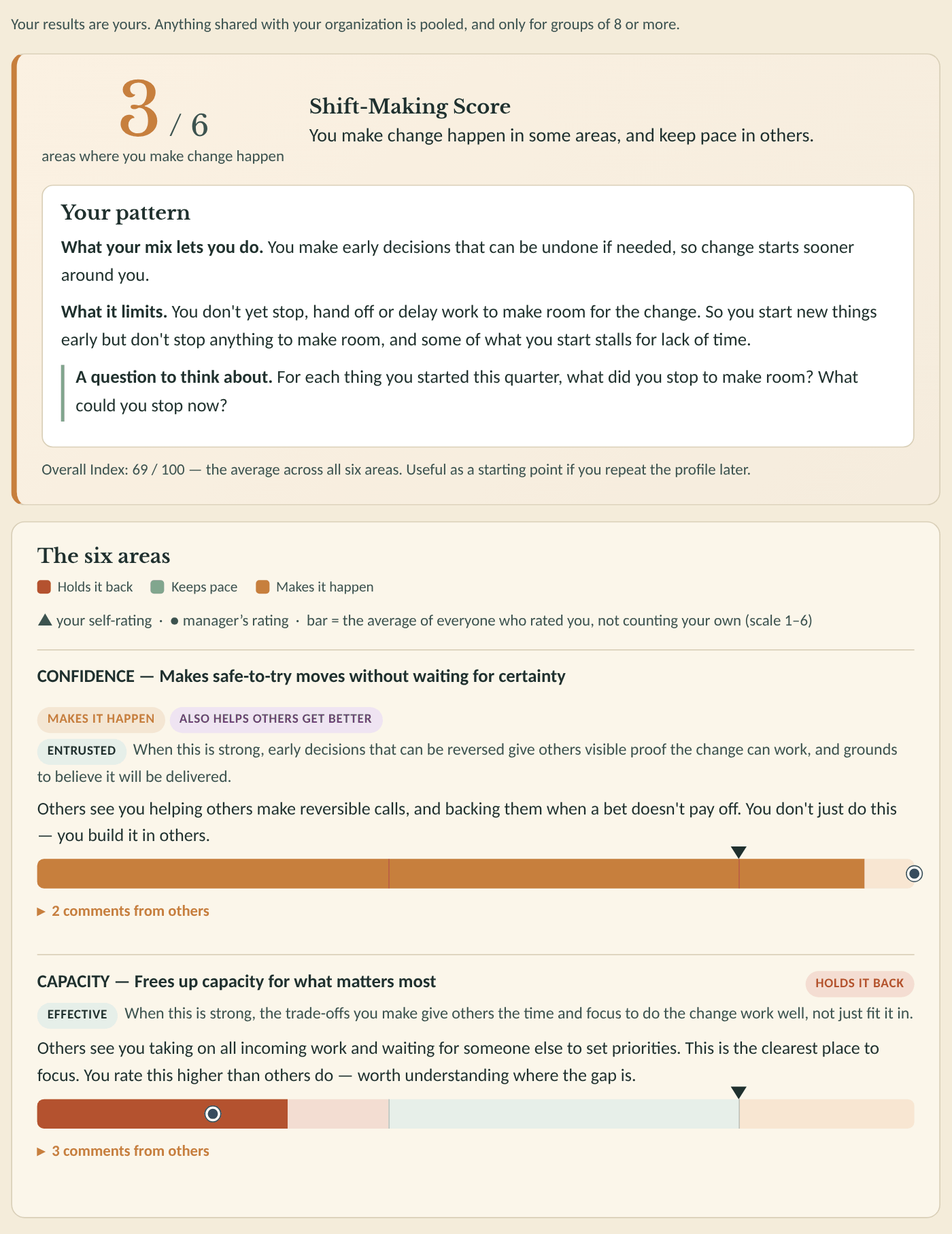
The third column is the experience each area produces in the people around a leader when it is strong. The report states it for every area in a fixed line, the same for everyone, so a leader reads their ratings against what those ratings mean for others. For Capacity: “When this is strong, the trade-offs you make give others the time and focus to do the change work well, not just fit it in.”
Navigate or make: the line the scale is built on
This change leadership 360 assessment does not use an agreement scale. Nobody is asked whether they “strongly agree” that a colleague is adaptable. For each area, raters read six short descriptions of what someone might actually do and pick the one that matches what they have seen this person do in the last twelve months. The six steps are the same in every area.
| What the person does | Where it lands |
|---|---|
| Builds this in other people | Makes it happen |
| Gets it moving when it isn’t | Makes it happen |
| Moves it forward once it’s underway | Keeps pace |
| Handles their own part | Keeps pace |
| Stays out of it | Holds it back |
| Makes it harder for others | Holds it back |
The whole instrument turns on the middle pair: moves it forward once it’s underway versus gets it moving when it isn’t. The first describes most strong performers in most organizations. The second describes someone without whom the work would not have moved at all.
The question behind every rating: would this have moved without them?
That question is also the guard against rewarding visibility. The person who starts ten things and finishes none of them does not rate as a shift-maker, because every gets it moving description is written around movement that lands: commitments delivered, work actually stopped to make room, the work kept going through a correction.
One area in full: freeing up capacity
Here is what raters see for one of the six areas. Every description names something a rater could have watched happen, and in most cases the step above where a person sits becomes their development goal, already written.
| Step | What the rater has seen |
|---|---|
| Builds this in other people | Backs others when they make hard trade-offs — stopping, delegating, or delaying work — even when those calls get questioned. People around them reprioritize without asking permission first. |
| Gets it moving when it isn’t | Makes hard trade-offs to free up capacity — stopping, delegating, or delaying work within whatever scope they hold — and the freed-up time goes to what the change needs. |
| Moves it forward once it’s underway | Puts the trade-off in front of whoever can decide it, with a recommendation attached: if this, then not that. |
| Handles their own part | Meets their own commitments but absorbs the extra work themselves. The strain doesn’t show to anyone else. |
| Stays out of it | Accepts all incoming work and waits for someone else to set the priorities. Passes conflicts upward without suggesting a way through. |
| Makes it harder for others | Takes on more than can be delivered and misses across most of it — or quietly lets commitments drop without flagging them. Either way, others redo or absorb the shortfall. |
How the results are read
Most change leadership 360 assessment reports lead with an average. This one leads with a count, because the average hides the finding.
- The Shift-Making Score leads: how many of the six areas sit in Makes it happen, from 0 to 6. A person rated the same middling step in all six areas and a person who is outstanding in two and holds things back in two can share an average and need completely different next moves.
- Your pattern pairs the person’s strongest area with their weakest and names what the weak one costs the strong one, with a question to think about. Someone who makes early, reversible decisions but never stops anything to make room starts things that stall for lack of time. That is one sentence a leader can act on.
- Self against others. Each area shows the person’s own rating, the manager’s, and the average of everyone else. Where self runs a step or more ahead of others, the capability is intended but not landing. Where it runs behind, it is often real and under-claimed.
- One area, one next step. The report names the single area to work on and the behavior that would show progress, taken straight from the descriptions above. A six-part development plan is a way of doing nothing about all six.
- An Overall Index from 0 to 100, kept low-key, as the baseline for running the profile again later.
A profile that keeps pace everywhere and makes change happen nowhere is not a weak leader. It often says as much about the organization as about the person, and the coach edition says so.
How the change leadership 360 assessment runs
- Who gives feedback: the person, their manager, at least three peers or cross-team colleagues, and, if they have them, their direct reports. Peers matter most for two areas that are close to invisible from above: rallying people they don’t lead, and freeing up capacity
- For each rater: six areas, one description picked in each, plus one required line of evidence, then a few optional open questions at the end
- One link, no names. The facilitator sends a single link or QR code. Each rater picks their relationship to the person, and no name is attached to any response
- “Haven’t observed or experienced this” is always an option. It is set aside and never counts against the person, so a lack of visibility is not scored as a lack of capability
- Rate what happened, not how it was said. Raters are told to pick what other people were able to do as a result, so a leader who works in writing, one-to-one, or in a second language is not marked down for not speaking up in meetings
- A minimum before any result: the person, the manager and three peers must respond before a report is produced
Who sees the results
The report goes to the person assessed. It reaches their manager only if the person chooses to share it. The opening line of every report says it plainly: “Your results are yours. Anything shared with your organization is pooled, and only for groups of 8 or more.”
- Peer and direct-report ratings are pooled with everyone else’s. A peer-only or direct-report-only view appears only where three or more have responded. The manager’s ratings appear as the manager’s view
- Written comments are shared with the person word for word, mixed together, never labeled with a name or relationship, and only once the minimum has responded. Raters are told this before they write
- The coach is IPL or an IPL-certified coach outside your HR line
This change leadership 360 assessment is a development tool, not a review or a ranking. That is a practical rule as much as an ethical one: the moment ratings feed a promotion or a layoff list, they become political, and the data stops being worth collecting.
What you get
- The person’s report: the Shift-Making Score, Your pattern, all six areas with what each one creates for others, comments from colleagues in their own words, the one next step, and where they already help others get better
- A coach edition for the debrief: everything in the person’s report, plus the numbers behind each area, flags with what each means and what to do, every comment tagged by type of rater, and debrief prompts, including what in the person’s role or setting helps or limits them
- A coach debrief, strongly recommended. The person’s report is written to stand on its own when there isn’t one
- A baseline for running the profile again, so a leader can see what moved
Questions about this change leadership 360 assessment
How is this different from a standard 360?
Three ways. It measures one thing, making change happen, rather than a broad leadership competency list. Raters pick a description of what they actually saw rather than agreeing with a statement, and every rating needs a line of evidence. And the result is one next step with the behavior already written, rather than a profile of strengths and weaknesses to interpret.
Can we use it for promotion or performance decisions?
No. It is built and contracted as a development tool. Raters are told so before they answer, and that promise is what makes their answers honest.
Does it favor outgoing leaders?
It is written not to. No description rewards speaking up, pushing back, or saying something in the room. Each one names what other people were able to do as a result, so the same act counts the same whether it happened in a meeting, a document, or a one-to-one conversation.
What if a rater hasn’t seen part of the person’s work?
They choose “Haven’t observed or experienced this” and that area is left out of their ratings. The coach edition shows how many raters couldn’t judge each area. A high rate is a finding about who can see that part of the work, not about the person.
See what the Shift-Maker Profile shows before you run it. The full sample report for a fictional leader: the Shift-Making Score, Your pattern, all six areas, and the one next step. Get the sample report →
The Shift-Maker Profile is one of six diagnostics in the Shift Diagnostics Suite: the others focus on the shift itself, and this one focuses on who makes the shift happen. See them side by side, or read about the change readiness assessment, its natural pair. One reads whether the organization’s conditions are in place; the other reads whether its people make change happen inside them. Capable people inside weak conditions is capability you’re wasting.