

Change adoption assessment: where are we in leading this specific change, and where does leadership attention need to go next?
A change adoption assessment that only counts who has switched over tells you how a change landed once it is too late to help it land. Ours is Our Shift Journey. It reads one named change across everyone it affects while the change is still moving: where each person is on the transition, whether the conditions for this change are in place, and whether people actually feel them.
Best when one named change is underway (a restructure, a system rollout, an integration) and you need to see how it’s landing across people.
Request a walkthrough → · Get the sample report →
What a change adoption assessment should read
Adoption is not one number. Three layers, each answering a different question, and each one incomplete without the other two.
| Layer | The question it answers | What comes back |
|---|---|---|
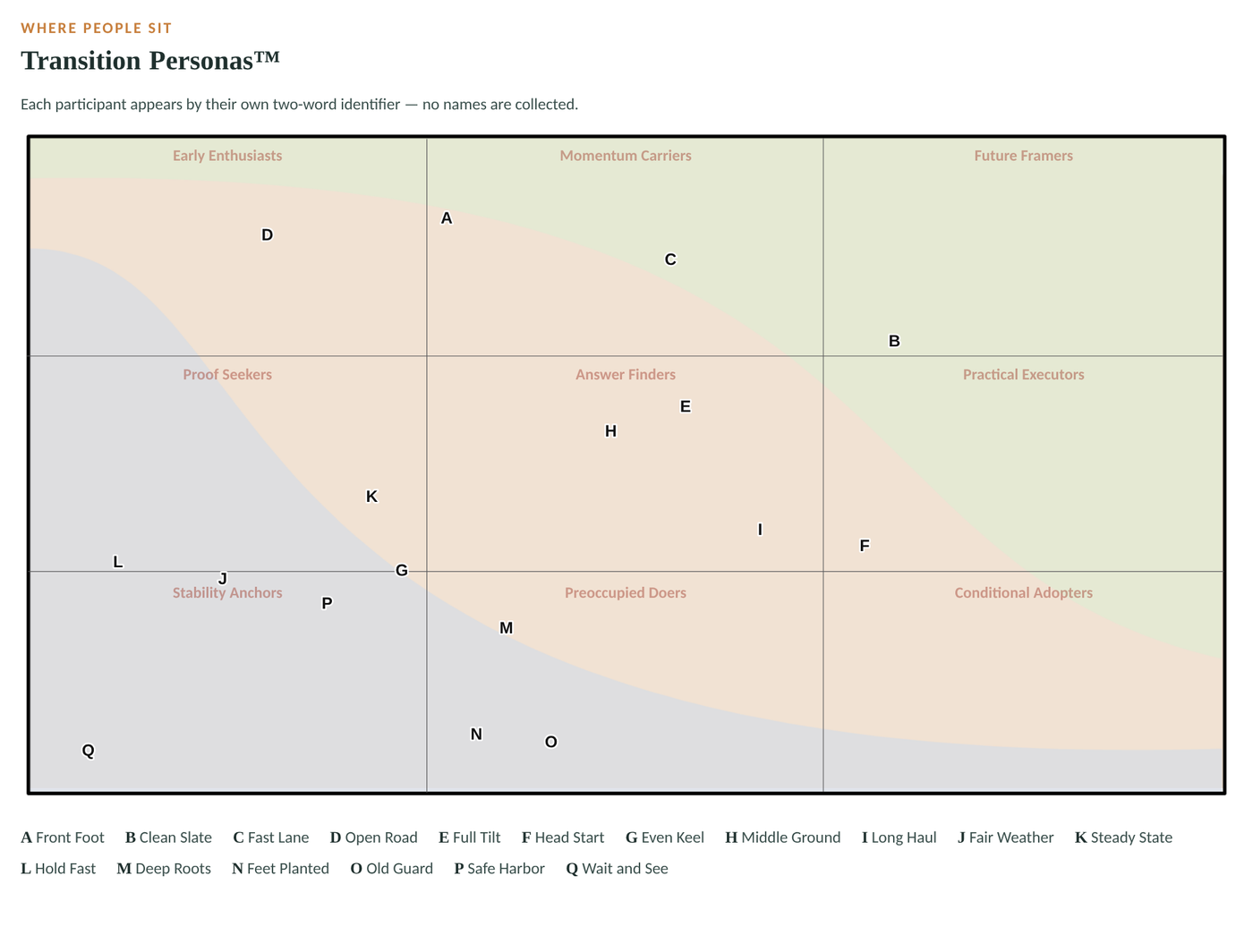
| Transition Personas™ | Where is each person on the transition, and how are they engaging it? | One of nine personas per person, plotted together on a single grid |
| Traction Conditions™ (6Cs) | Are the organizational conditions for movement present, for this change, right now? | Strength and agreement on each of the six conditions |
| Shift Experiences (6Es) | Are people actually experiencing the outcomes this change requires? | Strength and agreement on each of the six, plus how many say it is too soon to tell |
Nine ways of meeting a change
Every person is placed on two axes: how far along they see the change, and how ready they are to move it forward. Where the two meet names one of nine Transition Personas. A persona is a reading of how someone is meeting this change right now, not a personality type, and none of the nine is the wrong one to be.
| Persona | In their words |
|---|---|
| Early Enthusiast | “I’m all in!” |
| Momentum Carrier | “Keep it moving” |
| Future-Framer | “What’s next?” |
| Proof Seeker | “Show me evidence” |
| Answer Finder | “I need specifics” |
| Practical Executor | “Tell me how” |
| Stability Anchor | “What isn’t changing?” |
| Preoccupied Doer | “Too busy right now” |
| Conditional Adopter | “Why should I?” |
The group grid is where the read starts. An average would tell you the room is lukewarm. The grid tells you that a third of it is ready to run while another third is waiting to hear what isn’t changing, and that those two groups need different things from their leaders this month.
In place, but not yet felt
Each condition the organization puts in place is meant to produce something people experience. The assessment measures both sides of every pair, which is what lets it tell a design problem from a delivery problem.
| Condition (what we put in place) | Experience (what people live) |
|---|---|
| Clarity | Enlightened: “I know what the change entails, why it is happening, and what success looks like.” |
| Connection | Engaged: “I understand how this change affects me, and I am involved in executing the change within my role.” |
| Confidence | Entrusted: “I believe in my own and others’ ability to deliver, grounded in mutual trust and proven commitment.” |
| Capability | Equipped: “I have the knowledge, tools, and support needed to perform confidently within the new reality.” |
| Capacity | Effective: “I have the time, focus, and ownership to deliver on this change while managing other priorities.” |
| Change-Agility | Empowered: “I have the authority and accountability to shift as needed to make this change succeed and endure.” |
When a condition reads strong and its paired experience reads weak, the plan is not the problem. The condition exists on paper and is not reaching people. That calls for a different response from a condition that is missing outright, and a change adoption assessment that reads only one side cannot tell the two apart.
You don’t switch a condition on directly — you build it through what people experience.
How to read the results
Every condition and every experience carries a strength score from 0 to 100 and an agreement score from 0 to 100, reported in plain language in the room.
- Conditions: Strong, Mostly in place, Weak spot, or Not in place. Below 60, a condition is holding the change back. At or above it, the change can lean on it.
- Experiences: Nearly all feel it, Most feel it, Some feel it, or Few people feel it.
- Agreement: Mostly agree, Mixed views, Split, or Far apart. A middling score that everyone shares is a different problem from the same score made of two camps.
- “Too soon to tell”: left out of the scores, and reported on its own. A strong experience score resting on a high too-soon rate is a readiness caveat, not a clean strength.
How the change adoption assessment runs
- 18 rated questions, plus two open questions: what each person needs most right now, and their advice on the one thing that must be done to make the change succeed
- Everyone the change affects, answering about one change, named in the survey so nobody rates the wrong one
- Fitted to the session. Your organization’s name and the change’s name appear in the questions. For a leadership cohort, the condition statements can be reworded so each leader rates their own team
- Code names, never real names. Each person picks a two-word identifier, which is how they find themselves on the group grid without anyone else knowing which dot is theirs
- Role-level breakouts only where a level has five or more people. Open comments appear only once five people have answered, sorted so no one’s two answers can be paired
- Built for a live workshop debrief, facilitated by IPL
What you get
- A live dashboard that fills as responses land: the persona grid, the conditions, the experiences, how the group answered each question, comments in people’s own words, and the role-level comparison
- Group Alignment. For each signal, what results like these usually point to, the questions to put to the group, and next steps. Starting points for the conversation, not final answers
- A group report in two editions, one for the client and one for the facilitator with the full alignment narrative
- A report for each participant, by code name: their persona, what helps most from here, and every answer they gave set against the group’s. The facilitator decides whether to hand them out
Questions about this change adoption assessment
How is this different from a change readiness assessment?
A change readiness assessment reads the conditions underneath every change an organization takes on. This reads one named change while it is moving. Both use the same six conditions and the same rating scale, but the statements differ and so do the numbers: same ruler, different thing measured. Readiness tells you whether the organization is set up for change in general. Adoption tells you how this one is going.
Why plot people instead of averaging them?
Because the average is usually the least true number in the room. The persona mix shows the biggest group, the main tension between groups, and the outliers who see something the rest have missed. That is what a leader can act on in the next meeting.
Can people see where they landed?
Yes. Each person finds their own code name on the group grid in the session, and can save a copy of their own answers. Nobody else can tell which point is theirs.
Is the reading done by AI?
No. Placement on the grid comes from a fixed scoring engine, so the same answers always land in the same place. The Group Alignment prompts are written in advance and triggered by the results, not generated.
See what Our Shift Journey shows before you run it. The full sample group report: the Transition Personas map, the conditions for the change, and where they are in place but not yet felt. Get the sample report →
Our Shift Journey is one of six diagnostics in the Shift Diagnostics Suite. See them side by side, or read about the change fatigue assessment. Our Shift Journey reads how an organization is navigating one change, where My Shift Atlas reads how each person is navigating all of them.